
Florence County Court Records After Arrest
After a Florence County jail arrest, records split into two tracks. The jail track answers whether the person was booked into FCDC and whether the person is current or released. The court track answers what charges were filed, which court has the case, what bond or hearing events appear, and how the case ended. For the custody side, use Florence County jail inmate records. For booking photos, use Florence County jail mugshots.
Florence County criminal case records are searched through the South Carolina Judicial Branch public index system. The statewide case-records page links to Florence County's Public Index and notes that cookies and JavaScript are needed. It also notes that, as of January 1, 2026, home address information is no longer displayed on the public index for new and existing cases. If an address is absent, that is a privacy rule in the court system, not proof that the record is wrong.
Search Florence County Court Records After Arrest
The Florence Public Index is the primary public search point for court records after a jail arrest. Search by party name when the case number is unknown. Search by case number when it appears on a warrant, bond paper, citation, or clerk record. If the case is too new to show in General Sessions, check Magistrate or Municipal paths and try again after filing activity occurs.
- Confirm the booking through the FCDC portal or FCSO feed.
- Write down the full name, booking date, charge wording, and any case or warrant number.
- Search Florence Public Index by party name or case number.
- Open the case detail and compare filing date, court, charge description, statute or CDR code, bond events, and disposition.
- Check Magistrate, Municipal, or General Sessions records based on the offense and case path.
- Contact the Clerk of Court for older files, certified copies, or records not shown online.
The Florence Public Index portal screenshot shows the official case search environment for Florence County court records after a jail arrest.
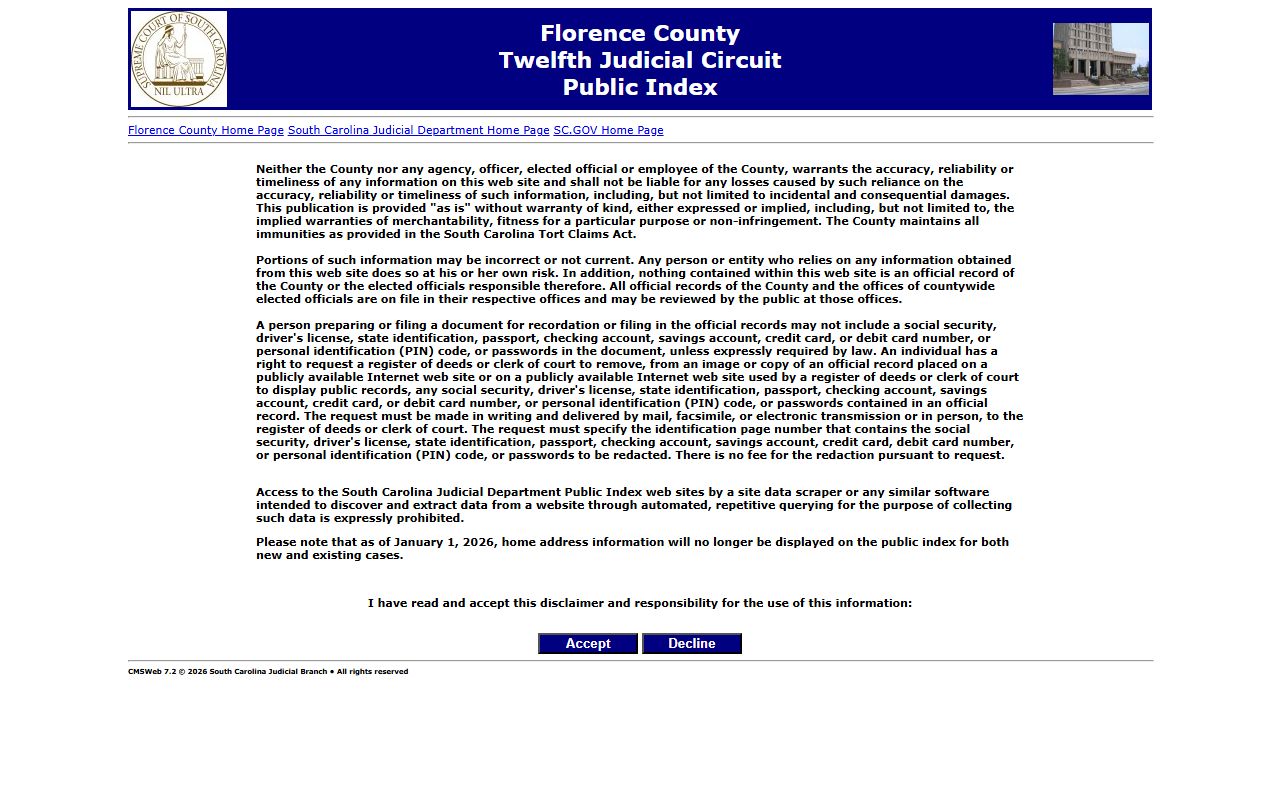
The portal is separate from the jail roster, so a current custody result and a court case result should be compared before drawing conclusions.
Florence Court Records Search Fields
The court index does not search the same fields as the jail roster. Court records after a jail arrest rely on party names, case numbers, court types, and date filters. These fields help separate defendants with similar names and help locate older or lower-court cases.
| Field Label | Type | Required | Notes |
|---|---|---|---|
| County | County selection | Yes | Select Florence from the statewide case records search. |
| Case Number | Text | No | Best when known from warrant, bond, citation, or clerk paperwork. |
| Party Name | Text | No | Search by defendant or party name. |
| Court Type / Court Agency | Dropdown or filter | No | General Sessions, Common Pleas, Family, Magistrate, or Municipal availability varies. |
| Date Range | Date fields | No | Useful for recent arrest or hearing windows. |
Filed Charges After Florence Arrest
Booking charges can change. Law enforcement may book a person under one charge label, while the solicitor later files, amends, reduces, dismisses, or presents a different charge in court. South Carolina prosecutors are called solicitors. Florence County's official solicitor page identifies E.L. "Ed" Clements III for the county, and solicitors prosecute criminal offenses in circuit court.
| Document | Who Uses It | What It Does |
|---|---|---|
| Complaint or warrant | Law enforcement, magistrate, or prosecutor path | Starts or supports an initial charge after arrest. |
| Information | Prosecutor | States formal charges when that procedure applies. |
| Indictment | Grand jury in higher criminal cases | Formally charges serious cases for General Sessions prosecution. |
The Florence County Solicitor page is the local prosecutor source for filed-charge context.
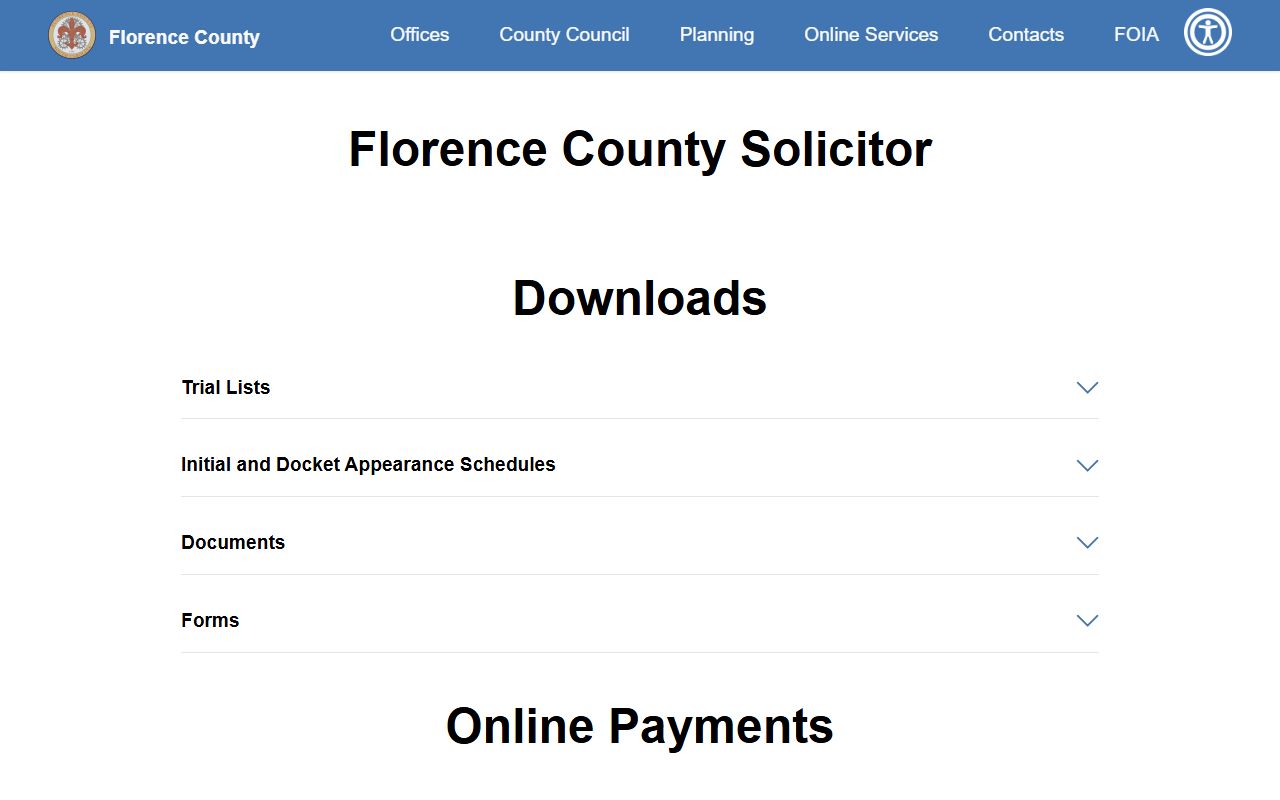
The solicitor source is useful when a roster charge no longer matches the formal court charge.
Florence County Charge Status
Charge status is the court-record term that shows where an accusation stands. A pending charge is not a conviction. A dismissed or nolle prossed charge should not be described as guilt. A bond event, bench warrant, or hold can affect custody even when the charge list looks simple.
| Status | What It Means |
|---|---|
| Pending | The charge remains open and has not reached a final disposition. |
| Amended or reduced | The prosecutor or court changed the charge from the original wording. |
| Dismissed | The charge was dropped by court order or other case action. |
| Nolle prosequi | The solicitor chose not to continue the charge. |
| Convicted or guilty plea | The case resulted in a finding or plea of guilt. |
Bond After Florence County Arrest
Bond connects the jail record to the court record. After a Florence County arrest, a person may be held pending a bond hearing or first appearance. Magistrate or municipal judges often handle initial bond issues, and General Sessions cases proceed through the solicitor and circuit court. A no-bond hold, bench warrant, probation or parole hold, out-of-county hold, federal hold, or immigration detainer can prevent release even when one charge has a dollar amount.
| Bond Type | How It Works |
|---|---|
| Cash bond | Money is posted with the proper court or jail path if eligible. |
| Surety bond | A licensed bondsman or surety posts a bond when allowed. |
| Personal recognizance | Release is based on a promise to appear, sometimes with conditions. |
| No-bond hold | Money alone will not release the person until the hold is resolved. |
Warrants and Florence Court Records
FCSO publishes an active warrants digest with card-style public warrant entries. A warrant can lead to a jail arrest, and the resulting court records may later show bench warrant activity, bond forfeiture, failure to appear, or a General Sessions status change. The warrant digest is not the same as a full court index, so check both official channels when a warrant and a booking may be connected.
The FCSO warrant digest screenshot shows the official sheriff warrant-card format.
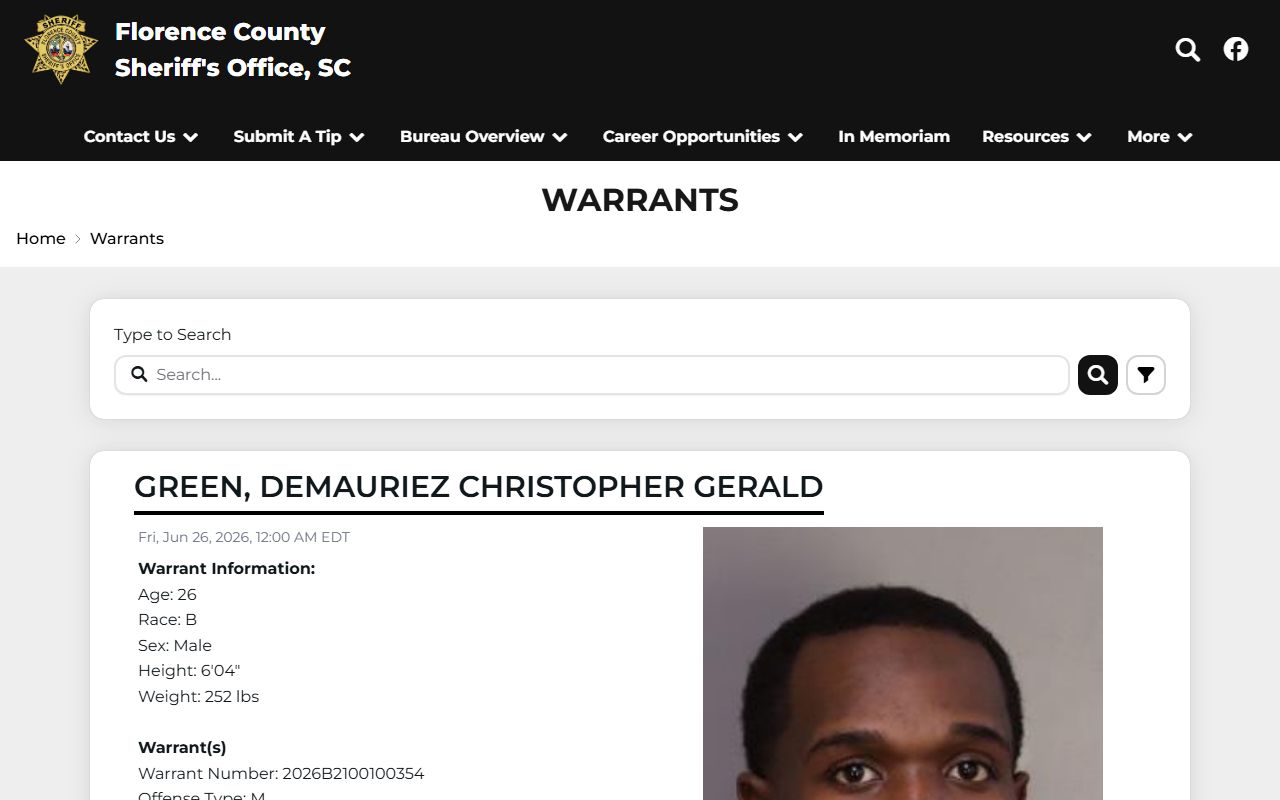
Public warrant information should be resolved through the issuing court, law enforcement, or counsel, not by responding to pressure-payment scams.
Charges vs Convictions
A charge is an accusation. A conviction is a final result after a guilty plea, verdict, or other qualifying disposition. Florence County court records after an arrest may show both, but they are not interchangeable. Public copy and personal decisions should avoid calling a person convicted unless the case record shows that outcome.
| Charge | Conviction | |
|---|---|---|
| Stage | Accusation after arrest or filing | Final result by plea, verdict, or judgment |
| Meaning | Alleged offense | Legal finding or admitted guilt |
| Can change | Yes, charges may be amended or dismissed | Changes only through appeal, post-conviction relief, pardon, or other legal process |
Sealed and Expunged Records
South Carolina has an expungement process for eligible non-convictions and certain offenses. The research points to S.C. Code Section 17-22-910 and related provisions, plus the South Carolina Judicial Branch expungement and pardon FAQ. Expungement can affect public access to official court and arrest records, but eligibility depends on the charge, outcome, timing, and prior record. A roster photo or booking entry should not be assumed removable until the court record is resolved.
| Sealed | Expunged | |
|---|---|---|
| Public access | Hidden or restricted from public view | Destroyed or treated as removed under the order |
| Best source | Court order and clerk guidance | Solicitor, clerk, and expungement order |
| Florence workflow | Check the Public Index and Clerk of Court | Use the South Carolina expungement process, then address agency records |
Florence Court Records Contacts
The Clerk of Court is the better route for older files, certified copies, and court records not visible online. The South Carolina Judicial Branch courthouse page lists Clerk Doris Poulos O'Hara, 181 N. Irby Street MSC-E, Florence, SC 29501, phone 843-665-3031, and fax 843-665-3097. The solicitor's Florence office is listed at 180 N. Irby St., Florence, SC 29501, phone 843-665-3091, with email Solicitor@florencecountysc.gov.
The South Carolina Judicial Branch courthouse profile identifies the Florence County courthouse and clerk contact information.
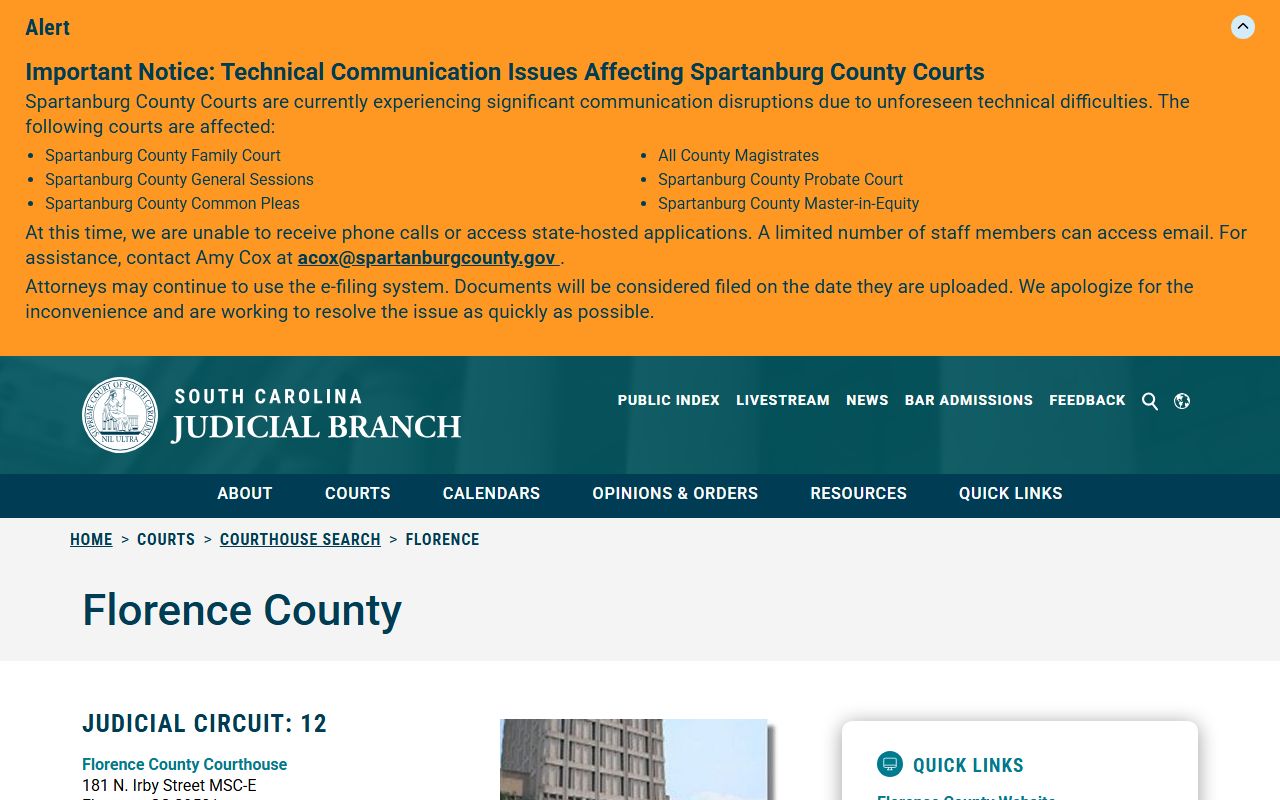
Use the courthouse source for certified court copies rather than asking the jail for a formal case disposition.
Restricted Florence Court Records
Some records are withheld, redacted, or limited. Juvenile information, medical details, sensitive law-enforcement material, security information, and records whose release would interfere with proceedings can be restricted under South Carolina law. SCDC also excludes juvenile offenders and current fugitives from its public inmate search. When a record is missing from a public portal, the reason may be timing, court type, privacy redaction, expungement, or a non-public category.
Important: Public court and roster lookups are not FCRA consumer reports and should not be used for regulated screening decisions.